Belonio

Erin Rasmussen

Dr TLUD (Paul S. Anderson) would like to share recent documents about rice husk gasifier technology and its application from Alexis T. Belonio (Professor and Engineer) of the Center for Rice Husk Energy Technology (CRHET).

The first four documents describe stove developments through CRHET’s collaboration with fabrication shops. These stoves provide rural households and small cottage industries new options for clean cooking using agricultural wastes, like rice husks, as fuel.

  1. Batch Type Rice Husk Gasifier Stove, Model RHGS-12D
    (Document URL: http://drtlud.com/wp-content/uploads/2011/12/rhgs1.pdf )
  2. Continuous Type Rice Husk Gasifier Stoves, Models 10D, 12D, and 14D
    (Document URL: http://drtlud.com/wp-content/uploads/2011/12/rhgs2.pdf )
  3. Firefly (BMG-1040SS), Quickfire (BMG-1050SS), and Wildfire (BMG-1060SS) Biomass Gasifier Stoves
    (Document URL: http://drtlud.com/wp-content/uploads/2011/12/rhgs3.pdf )
  4. A Two-Burner, Continuous-Type Rice Husk Gas Stove (CFRHGS Model 16D-2B)
    (Document URL: http://drtlud.com/wp-content/uploads/2011/12/rhgs4.pdf )
  5. Small-Scale Rice Husk Gasifier Plant for Community Street Lighting
    (Document URL: http://drtlud.com/wp-content/uploads/2011/12/rhgs5.pdf )

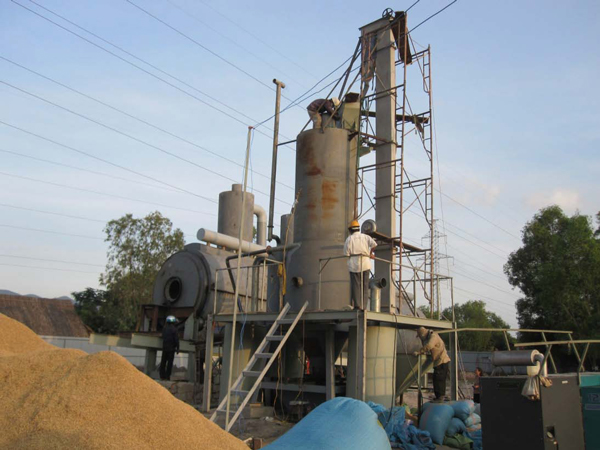
The fifth document describes a rice husk gasifier plant which produces enough electricity for community street lighting. This plant was developed by Suki Trading Corporation in Lapu-Lapu City, Cebu, Philippines in collaboration with Kanvar Enterprises and the Center for Rice Husk Energy Technology (CRHET).

Erin Rasmussen

Alexis Belonio, Victoriano Ocon, and Antionio Co

Garbage-In Fuel-Out (GIFO) Project,
Suki Trading Corporation, Lapu-Lapu City, Cebu, Philippines

This project is a cooperation between Suki Trading Corp. and Kanvar Enterprises and the Centre for Rice Husk Technoloy (CRHET).

Erin Rasmussen

by: Alexis T. Belonio, Emmanuel V. Sicat, and Francisco D. Cuaresma

Erin Rasmussen

Alexis Belonio, Bima Tahar, and Bonny Minang

A super low-cost, blue-flame rice husk gas stove was recently developed in Indonesia to provide households with an affordable clean-burning cooking device using rice husks as fuel.

Within the 3 years of development on rice husk gasifier stove, PT Minang Jordanindo Approtech has finally come up with the super low-cost, blue-flame rice husk gas stove carrying a selling price of US$10 to 15, which is very much cheaper as compared with the previous model with a selling price of US$20. With this development, consumers don’t need to amortize for the stove, as what is currently practiced in villages in Indonesia, for them to acquire a unit of the stove in order for them to save money on fuel. Moreover, this stove is now made available to end users at a low cost, freeing the distributors from the task of devising financing schemes just to make the technology affordable to the local households.

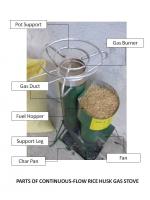
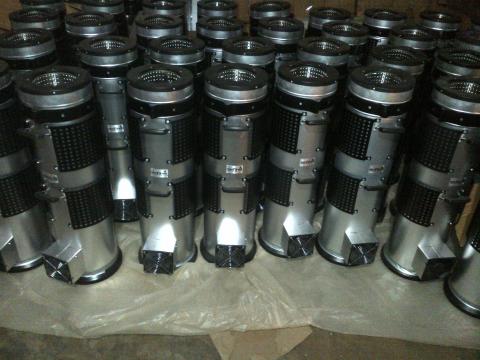
As shown, the stove consists of only few parts. It was designed and made so simple to maximize the use of materials and to simplify the production using locally available resources. This stove model has the following basic parts: (a) the casing is made of tin can and can be bought at a very low price from a Can Factory; (b) the reactor can be subcontracted from a sheet metal manufacturer as well as the stove cover
and the burner; (c) the fan, which uses DC 12 volt, 2 watt supplies the required air to gasify rice husks. The flame coming out of the burner is bluish in color, which indicates a very clean gas. It has low black carbon emission of about 50 ug/m3 and below. The CO2 emission is about 0.6 kg CO2 per kg rice husks.

Erin Rasmussen

Alexis T. Belonio, Daniel A. H. Belonio, and Lucio Larano, August 2010

Tom Miles

A CLEAN BURNING COOKSTOVE DEVELOPED IN VIETNAM
Alexis Belonio, Tran Binh, Doan Thi Minh Nguyet, and Bui Dinh Hai
VINASILIC SJ, Socialist Republic of Vietnam and Center for Rice Husk Energy,
Philippines January 24, 2010

Tom Miles

Rice-powered stove ignites new hope for poor farmers

Alexis BelonioAlexis Belonio

INVERTED-DOWNDRAFT COAL GASIFIER FOR SMALL SCALE INDUSTRY THERMAL APPLICATION
Alexis Belonio, Daniel Belonio, Fraciscus Tria Garleman, Bima Tahar, and Djoewito Atmowidjojo
Minang Jordanindo Approtech, November 2008

Coal Gasifier
Gasifier With Jet Burner

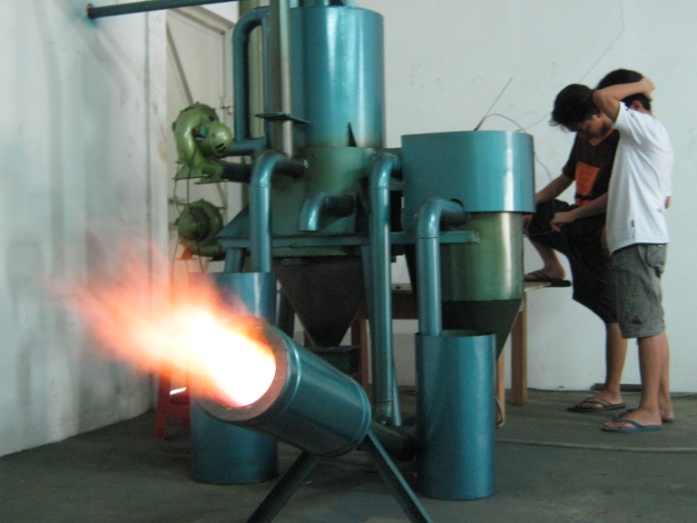
Fuel source for small-scale industry heating application is becoming expensive. This is more so for food, grain, and other processing industries in Indonesia where the energy sources for various processes are highly dependent on conventional fuel. At present, the cost of LPG went up to IDR 7,000 per kg while kerosene and diesel to as high as IDR 12,000 and IDR 5,500 per liter, respectively.

Tom Miles

SMALL-SCALE INDUSTRY COAL GASIFIER STOVE FOR FRYING FOOD PRODUCTS
Alexis Belonio, Daniel Belonio, Franciscus Tria Garleman, and Djoewito Atmowidjojo
Minang Jordanindo Approtech, Jakarta Selatan, Indonesia, November 2008

Tom Miles

MJA Biomass Gas Stove
Alexis Belonio, July 23, 2008
MJA Biomass Gas StoveMJA Biomass Gas Stove Burning Coal

Alexis Belonio writes (edited and annotated by Paul Anderson and Tom Miles):

Attached is a picture of my latest coal gasifier stove. This
is the same basic TLUD stove I have for wood charcoal and wood chunks.

For domestic use, I use carbonized coal (or coke) as fuel instead
of the raw coal. Coal can be used for the stove, but we don't want to promote
this as a fuel since it emits poisonous gas. I would prefer to use coal for
industry application where gas can be cleaned before it is released to the
atmosphere.

I provide only a small amount of coal fuel in the gasifier stove, enough
for cooking. This mean that the power output is only small and the
metal I use is a stainless steel.

I ignite the carbonized coal by using a wood charcoal that has been soaked in
kerosene as igniter. [This is a TLUD stove, so ignition is at the top.]

[In the Belonio TLUDs, the fan only blows the primary air. The
secondary air is
pre-heated as it rises naturally between the fuel cylinder and the outer
cylinder, finally exiting into the rising flow of combustible gases.]
The smoke in the coal gasifier I have was eliminated [combusted] by mixing
preheated air with the gas generated from the reactor. I think
there is no need of [forced] mixing the secondary air by creating turbulence
with the combustible gases. Because in that case, you will need a
slightly bigger fan with enough pressure to push the air.
MJ Biomass Gas StoveMJ Biomass Gas Stove

Alexis Belonio
atbelonio@yahoo.com

Pages

Subscribe to Belonio